The landscape of American higher education is undergoing a seismic shift. As we navigate 2026, the traditional boundaries between “technical skills” and “core academic requirements” have blurred. Leading the charge in this curricular evolution is Java—a language that has transcended its role as a mere tool for software developers to become a foundational pillar of academic rigor across United States universities.
From the Ivy League to state polytechnics, proficiency in object-oriented programming (OOP) is no longer an elective luxury; it is a prerequisite for excellence. This shift is driven by the integration of computational thinking into non-STEM fields, including economics, behavioral sciences, and even digital humanities.
The Evolution of the “Core” Curriculum: Logic over Syntax
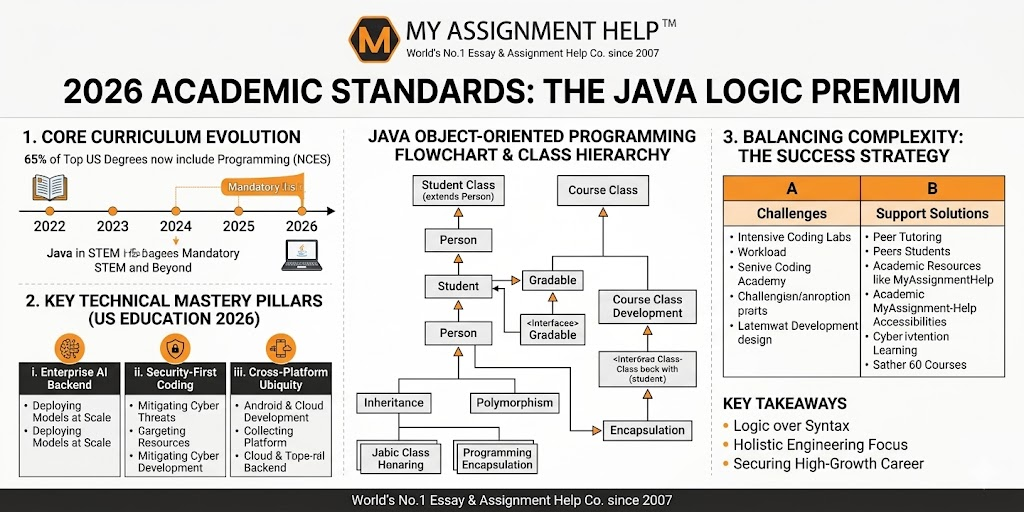
In 2026, data literacy is the new literacy. According to recent data from the National Center for Education Statistics (NCES), over 65% of top-tier US degree programs now incorporate at least one semester of programming. Java remains the preferred instructional language due to its strict syntax, which enforces logical discipline, and its “write once, run anywhere” (WORA) philosophy that mirrors the universal nature of scientific inquiry.
As the academic pressure mounts, students are finding that mastering Java requires more than just attending lectures—it requires a strategic approach to workload management. Many undergraduates in the USA are turning to specialized platforms to balance their intensive coding labs with general education requirements. For those struggling to keep pace with the rigorous curriculum, MyAssignmentHelp has emerged as a critical resource, providing comprehensive assignment help for students seeking to master complex algorithms while maintaining their overall GPA.
Data-Driven Insights: The Java Logic Premium
Recent labor market analyses by the U.S. Bureau of Labor Statistics (BLS) project a 25% growth in software development roles through 2032, but the academic impact is more immediate. The “Logic Premium” refers to the cognitive advantage gained by mastering Java’s strict structure.
| Metric | 2022 Average | 2026 Projection |
| Java-Integrated Courses (Non-CS) | 12% | 38% |
| Student Proficiency Requirements | Intermediate | Advanced |
| Average Starting Salary (Java Proficient) | $85,000 | $112,000 |
The Intersection of Technology and Social Awareness
While technical prowess is vital, the modern US education system emphasizes “Holistic Engineering”—the idea that code does not exist in a vacuum. Students are now tasked with building software that addresses systemic societal challenges, from algorithmic bias to sustainable energy distribution.
To succeed in this cross-disciplinary environment, students must be as fluent in social discourse as they are in syntax. Often, the inspiration for a groundbreaking Java project comes from exploring the Best Social Issues Topics for Students, which provides the ethical framework necessary to build technology that serves the public good. By combining technical logic with a deep understanding of current events, students are better prepared to enter a workforce that demands both hard skills and high emotional intelligence.
Future-Proofing Your Career with Java Logic
To remain competitive in the 2026 academic and professional landscape, students should focus on three specific pillars of Java mastery:
- The Rise of Enterprise AI: While Python dominates AI research, Java remains the backbone of the enterprise-grade systems that deploy these AI models at scale in the US corporate sector.
- Security-First Education: With cybersecurity threats at an all-time high, Java’s robust security features make it the ideal environment for students to learn safe coding practices.
- Cross-Platform Ubiquity: From Android development to cloud computing, Java’s versatility ensures that a student’s academic efforts have immediate real-world applications. supply chain management software price, etruesports etsjavaapp guide, Keine Karriere-Subdomain Gefunden, global citizenship kronosshort, bfnctutorials
Summary: Navigating the 2026 Academic Standard
- Java as Logic: Beyond coding, Java reinforces the structured problem-solving skills required in modern American academia.
- Market Alignment: Proficiency aligns directly with high-growth, high-salary sectors in the US economy.
- Holistic Growth: Success in 2026 requires a blend of technical mastery and an awareness of global social issues.
- Strategic Support: Utilizing academic resources can help students bridge the gap between classroom theory and practical application.
Frequently Asked Questions (FAQs)
Q1: Why is Java preferred over Python in US universities for 2026?
While Python is excellent for data science, Java’s “strongly typed” nature forces students to understand fundamental concepts like memory management and object-oriented design more deeply.
Q2: How can I improve my Java skills while handling a full course load?
Consistency is key. Practice coding for at least 30 minutes a day and leverage specialized academic support to clear up conceptual bottlenecks early.
Q3: Does Java proficiency really help in non-tech careers?
Yes. The logical structuring required in Java is highly transferable to law, project management, and strategic consulting.
Author Bio
James Sterling is a Senior Academic Consultant at MyAssignmentHelp. With over a decade of experience in the US higher education sector, James specializes in bridging the gap between technical skill acquisition and student success strategies. He is a frequent contributor to educational forums, focusing on the evolution of STEM curricula in North America.
References
- U.S. Bureau of Labor Statistics (2025). “Occupational Outlook: Software Developers.”
- National Center for Education Statistics (2026). “The Integration of Computational Thinking in Undergraduate Degrees.”
- IEEE Spectrum (2026). “The Top Programming Languages for Enterprise Deployment.”
About the Author